
Guide
The Best Linen and Organic Cotton Sheets for Hot Sleepers
Weave, fiber and the fine print on the label: seven sets worth a place on a warm-weather bed, from a Flemish mill to a Florida-friendly percale.
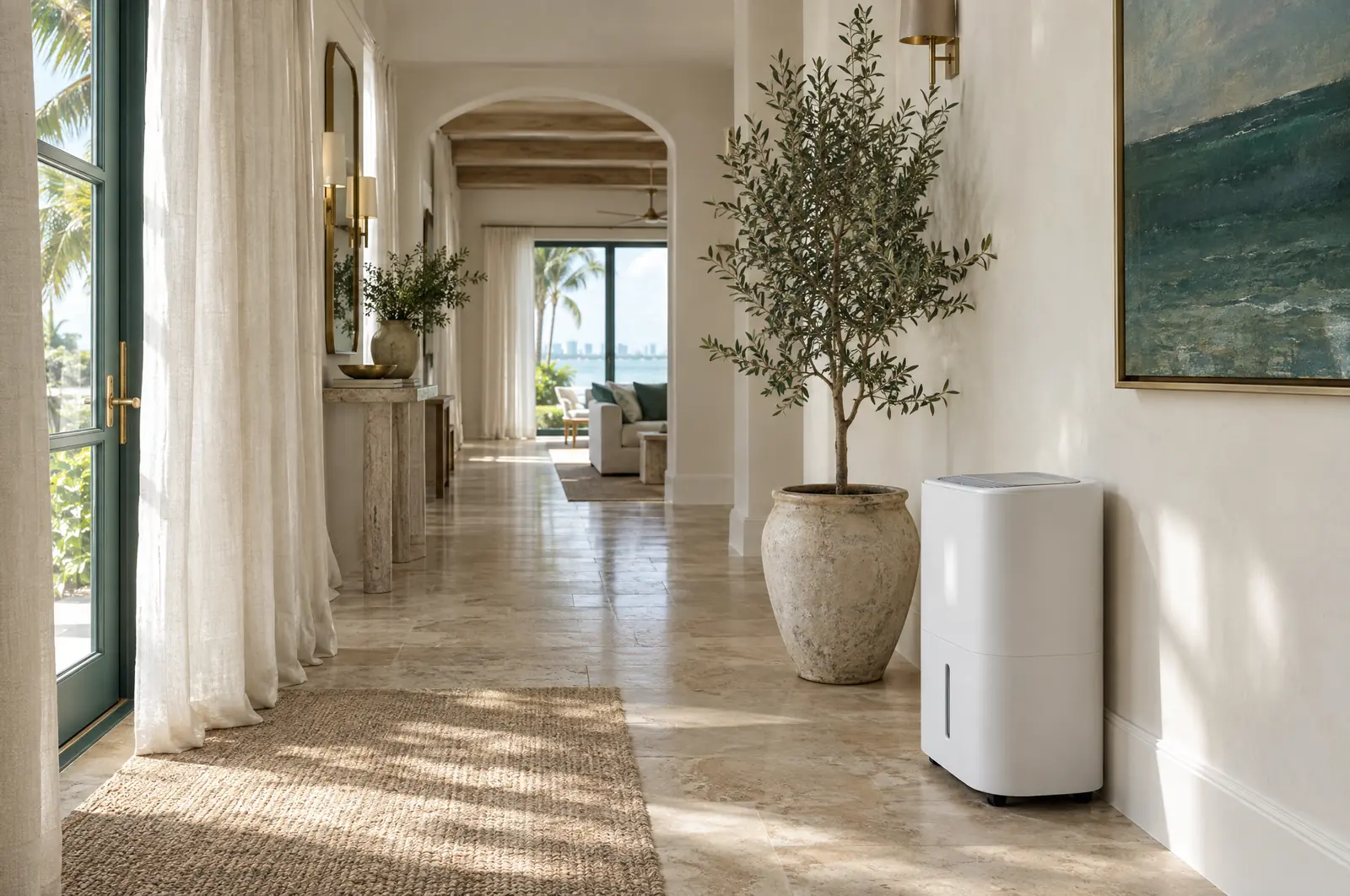
In a house that breathes sea air for most of the year, drying it is a matter of numbers. Here is how to read them, and six machines worth a look.
We choose from published evidence: specifications, efficiency ratings, certifications we verify on the certifier's own records, and reputable reviews. We have not used these products ourselves. This piece contains no affiliate links yet; when it does, they will be disclosed here.
Last checked: October 18, 2026. Certification details below were read from ENERGY STAR product records; we recheck them when this guide is refreshed.
A coastal house in South Florida lives with the weather. Warm, wet air arrives off the water through summer and hurricane season and settles into closets, linen cupboards and upholstery. Air conditioning removes some of it. A dehumidifier is for the rest: the shuttered guest suite, the closed-up house in August.
The U.S. Environmental Protection Agency is plain on the point. High indoor humidity can cause mold to grow on many things in a home, including furnishings and clothing, and the agency advises keeping indoor relative humidity below 60 percent, ideally between 30 and 50 percent 12. That range is the target every machine below should be judged against, and a simple hygrometer in the room will tell you whether you are meeting it.
A dehumidifier is a tool for keeping air in that range. It is not a remedy for mold that is already growing. EPA advises that a homeowner can usually handle a patch smaller than about 10 square feet; where there has been significant water damage or mold covers a larger area, it refers readers to its more detailed remediation guidance, and recommends that any contractor you hire has experience cleaning up mold 3. If mold is present, or if anyone in the house has a health concern, talk to a qualified professional and to your doctor.
Capacity is stated in pints of water removed per day, and the number on the box changed meaning a few years ago. Under the Department of Energy's revised test procedure, known as Appendix X1, portable dehumidifiers are tested at 65°F rather than the previous 80°F, to better reflect expected performance in a basement setting 46. Cooler air holds less water, so ENERGY STAR notes that a unit tested under the new procedure will likely report a smaller capacity than a comparable model did under the old one 4. Whole-home units are tested under their own conditions, including a ducted setup, at 73°F 6. Federal efficiency standards that took effect in June 2019 are measured on this basis 4, and the Department of Energy states that makers must still use Appendix X1 to show compliance 5.
The lesson: compare current ratings with current ratings. Makers of whole-home units often also quote a larger figure at 80°F; we give the ENERGY STAR figure and note the maker's.
Efficiency is measured as Integrated Energy Factor (IEF), in liters of water removed per kilowatt-hour. It includes the power a dehumidifier draws when it has cycled off, which the older Energy Factor did not 4. Higher is better. ENERGY STAR certification requires a minimum IEF that varies with the machine's type and size, under the Version 6.0 requirements that took effect on October 1, 2025 7. A smaller group of certified models also carries the ENERGY STAR Most Efficient designation, which appears on each product's record in the ENERGY STAR Product Finder 8. That record, not the box, is where we check.
Noise is published inconsistently, so we rely on independent measurement where it exists. Drainage matters more. A bucket is emptied by hand. Gravity drainage runs a hose from the unit to a floor drain, and Midea notes the hose must sit lower than the drain point on the machine 12. A built-in pump pushes water up and out, to a sink or through a window, which is often the only practical choice in a condominium or a slab-built house with no floor drain.
Portable units dry the room they stand in. Whole-home units connect to the ductwork and run out of sight; an AprilAire retail listing states that sizing should be done by a licensed technician or an AprilAire representative 22. For a large house closed up through summer, ducted is the considered answer; for a condominium or guest room, a good portable is enough.
Refrigerants are listed where published (HFC-32 on the Midea Cube's ENERGY STAR record 10, R-454B on the Santa Fe Ultra V100's ENERGY STAR record and specification sheet 2324). We report them; we do not rank on them.
Chosen from published ratings, ENERGY STAR records and independent reviews. None was used or tested by us.
Why it earns a place. It has a strong independent reputation: HouseFresh, which measures noise with a sound meter, called it the best home dehumidifier for those who cannot use an external drain 13.
Capacity and certification. 49.67 pints per day and an IEF of 2.01 L/kWh, ENERGY STAR certified, per the ENERGY STAR record for MAD50S1QWT-A (checked October 2026); that record does not carry the Most Efficient designation 9. The pump version, MAD50PS1QWT-A, shows the same capacity and IEF on its own record 10. Midea states the pump model can drain continuously to a sink or out of a window 11.
Price. [price?]
Who it suits. A large room, a closed-up apartment, or anyone who wants one capable portable rather than several small ones.
Why it earns a place. The Cube design at a size for a bedroom, dressing room or linen closet.
Capacity and certification. 20.16 pints per day and an IEF of 1.7 L/kWh, ENERGY STAR certified; not designated Most Efficient, per the ENERGY STAR record for MAD20S1QWT (checked October 2026) 15. Some retailers describe it as Most Efficient; the record does not support that. Midea states it suits spaces up to 1,500 square feet 16.
Price. [price?]
Who it suits. A single room in a condominium, or a pied-à-terre closed for part of the year.
Why it earns a place. A conventional upright portable with a practical case: GE states it removes 50 pints per day and has a built-in pump that can move water to a drain up to 16 feet away 17. GE lists automatic restart after a power outage, which matters in a season of brief outages, for a closely related model; we have not yet confirmed it for this one.
Capacity and certification. 50 pints per day, as the maker states. GE states the model is ENERGY STAR certified 17; we could not confirm a record for this model on the ENERGY STAR Product Finder at the time of checking. In October 2026 search results GE's own site showed this model at a clearance price, so it may be on its way out; check that it is still sold, and look up its ENERGY STAR status on the Product Finder before you buy 8. Researched, not tested.
Price. [price?]
Who it suits. A house without a floor drain where the unit must pump to a sink, and an owner who values automatic restart over compact design.
Why it earns a place. A ducted, whole-home unit for a house of moderate size, with a strong efficiency record.
Capacity and certification. 65 pints per day under the federal whole-home test and an IEF of 2.35 L/kWh, ENERGY STAR certified and designated Most Efficient, per its ENERGY STAR record (checked October 2026) 18. AprilAire rates it at up to 80 pints per day under its own conditions and lists a removable, washable filter 19.
Price. [price?], plus professional installation.
Who it suits. A single-family house or townhouse where the air handler and ducts are accessible and the owner wants humidity managed for the whole house.
Why it earns a place. The same platform, scaled for larger houses.
Capacity and certification. 85 pints per day and an IEF of 2.35 L/kWh, ENERGY STAR certified and designated Most Efficient, per its ENERGY STAR record (checked October 2026) 20. AprilAire's specification sheet gives 100 pints per day at 80°F and 85 pints per day at 73°F, both at 60 percent relative humidity, and a sound rating of 55 dBA when ducted 21.
Price. [price?], plus professional installation.
Who it suits. A larger house, particularly one left closed for weeks at a time in summer.
Why it earns a place. A whole-home unit that also brings in filtered outdoor air, which Santa Fe presents as a way to ventilate a tightly sealed house without adding humidity 24.
Capacity and certification. 85.62 pints per day and an IEF of 2.45 L/kWh, the highest of our picks, ENERGY STAR certified and designated Most Efficient, per the ENERGY STAR record for model 4047100 (checked October 2026) 23. Santa Fe's specification sheet lists an 8-inch ventilation duct intended to help meet ASHRAE 62.2 fresh-air requirements, a MERV-13 filter and R-454B refrigerant 24.
Price. [price?], plus professional installation.
Who it suits. A newer or renovated house built tight, where an HVAC contractor has recommended mechanical ventilation.
Read the owner's manual for your exact model number, which is the only authoritative schedule. From the makers' published material:
Sources checked 2026-10-18.
Guide
Weave, fiber and the fine print on the label: seven sets worth a place on a warm-weather bed, from a Flemish mill to a Florida-friendly percale.

Guide
Room by room, the everyday things worth replacing with something better made, better disclosed and built to last.

Guide
Behind the green cross, a short shelf of quiet, well-made basics. What they are, what is in them, and where to find them on either side of the Atlantic.

Explainer
The ingredient list, the fine print and the seals: what each one is actually telling you, and what it isn't.

Explainer
What federal health and environmental agencies advise once the water recedes, in the order you will need it.
Explainer
A reassuring word with no fixed meaning, and the better questions to ask instead.
Weekly, free
One considered pick, one beautiful find, one Palm Beach moment and one good deal, every week.